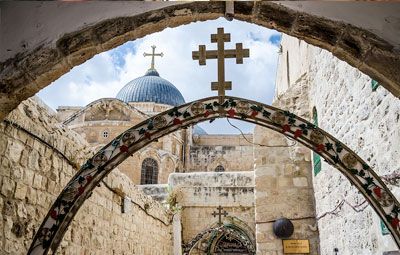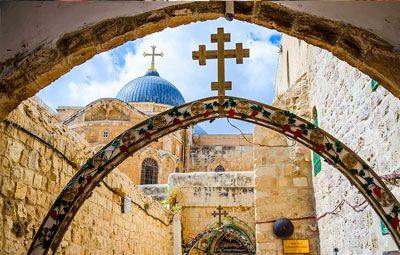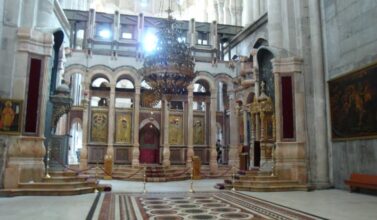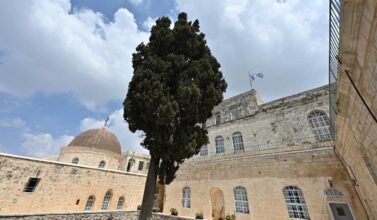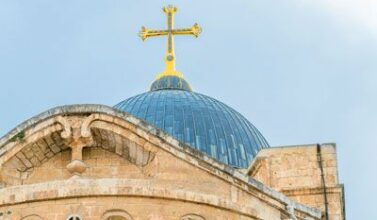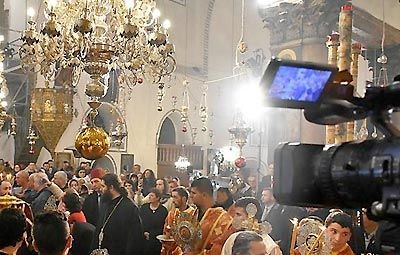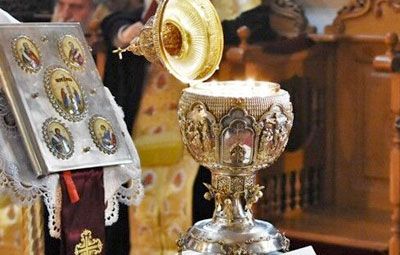
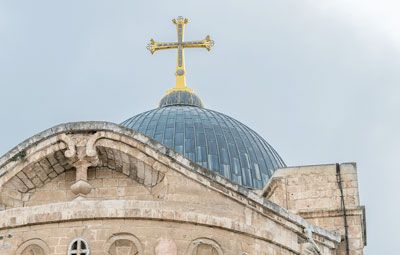
Nowadays the pilgrims enter the Church of the Resurrection through a single entrance which is called the Holy Door. Its dimensions are relatively large, its height exceeds five meters and its width is three meters. Its two door panels are made of pine and walnut wood and on the inside they are supported by two iron plates.
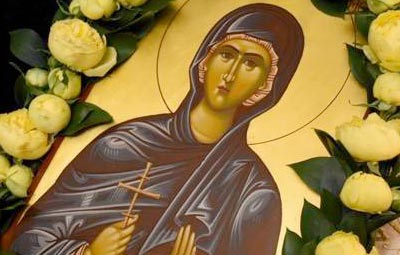
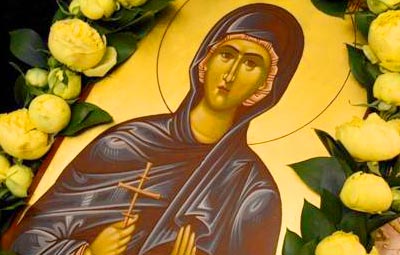
There are Arabic inscriptions engraved on its two ancient handles. On the right handle it is written: “Pilgrim, enjoy your desire. Enter in the Lord’s joy, in the luminous heaven… mother of churches”. On the left one it is written; “Strangers, enter into the courtyards of the Lord, in the tomb of Life, where the grace lives and blessed light prevails”. Beyond this entrance and in an easterly direction, there is another identical one, which was sealed in 1187. Both these entrances constitute the complex of the gates of the Church and are flanked by eleven white and greenish marble pillars, which end in Corinthian crowns. On the semi-circular panel, above the holy door there used to be engravings of Lazarus resurrection, Jesus’ glorious entrance in Jerusalem, the holy basin wash and the Last Supper. Now, they are kept in the Rockefeller Museum in Jerusalem. On the panel of the sealed entrance there were emblems, under which there used to be the gilded icon of the Virgin Mary, which survived until 1801 known also from the life of St. Mary of Egypt.
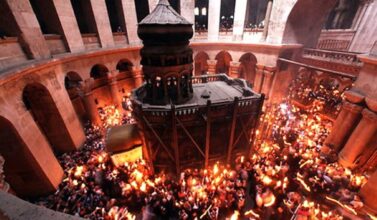
Before one enters the Church one can see on the left the middle pillar with a long crack in its lower part. According to tradition, in 1580, Murat III, having been bribed by the Armenians, granted them the right for the ceremony of the holy Light, the orthodox gathered in the holy courtyard where they waited for the outcome of the events. Despite the Armenian Patriarch’s hopeless attempt, the holy Light did not light up in the holy Aedicule or anywhere else within the Church. Instead, the marble pillar was torn and from the crack, the Orthodox received the holy Light. Emir Tounom, witnessing this miracle, was so impressed that he cried: “great is the faith of the Greeks”, an utterance that cost him his life. When the Sultan heard about this miracle, he issued a decree (firman) granting the Greek Orthodox Patriarch the exclusive right of receiving the holy Light. The Armenians of course, maintain their own explanation for the big tear on the pillar, according to which, some poor pilgrims, who could not afford the required “donation”, remained outside the Church. However, Divine Providence also provided for them, through the crack of the pillar.
During the night the Holy Door remains closed and its keys are kept by Muslim doormen from a specific family through hereditary right. Each time one of the Confessions wishes to open this gate to perform a service or for other reasons, it requests the doorman. He then opens it and guards it until the end of the event, when he locks it and departs. However the official opening and closing of this gate of the Church a special officiating requirement has been incorporated by which the presence of the Greek doorman is required.
|