|
|
 |
|
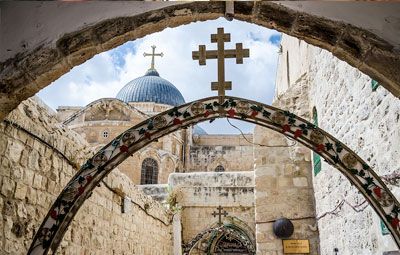
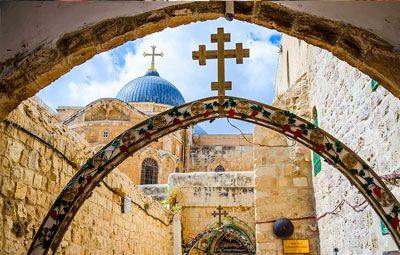
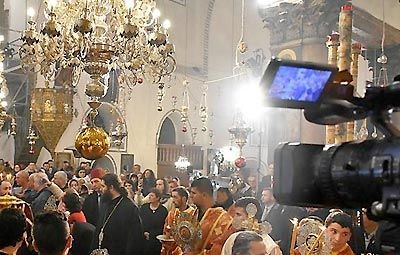
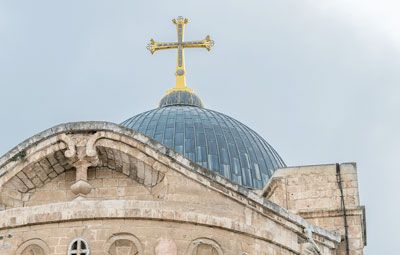
The Church of the Resurrection. |
|
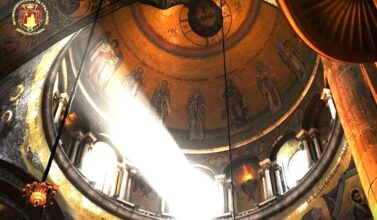
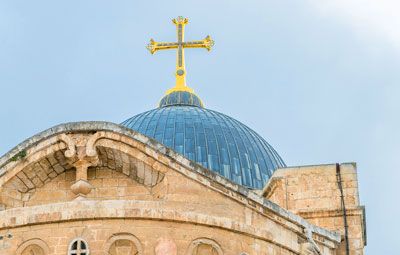
Palestine with Jerusalem constitutes the centre of the world. In this most important and vigorous in all that belongs to her, from the colours of the east rising and west setting sun, to the people and the esteemed locale it exists and radiates through the centuries an authentic composite presence of the Greek byzantine tradition. The Church of the Resurrection, the holiest monument of Christiandom constitutes the dream of every pious Christian to sometime be able to visit the Holy Land. In reality the most famous church of the Christian religion where Christ was crucified and resurrected, is not a single building but a complex of many and different buildings which are joined together. The interior area of the Church complex includes churches, chapels, shrines, bedrooms, corridors, first aid places etc. The same architectural irregularity is maintained even in the interior of the church, despite that the monuments maintain their self containment both in their interior and in their exterior.
The interior décor is varied with byzantine frescoes, icons and statues, with copper engravings of renaissance, together with mosaic walls. Within the Church of the Resurrection there are over ten holy places and shrines, connected with the Passion of Christ, the Crucifixion, the death, the burial and the Resurrection. The most important are:
- The Holy Apocathelosis (removal of the body from the Cross)
- The place where the holy women stood during the crucifixion.
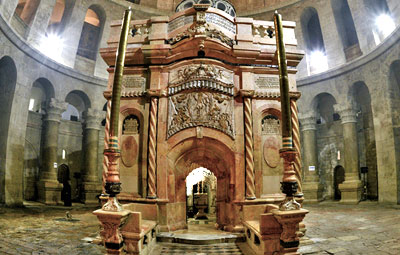
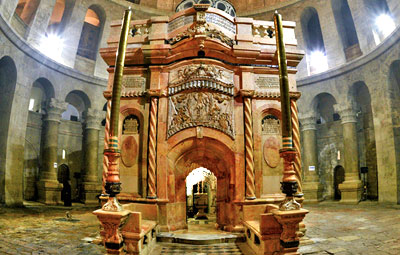
- The holy Edicule of the tomb of Christ and the Holy Stone.
- The Golgotha
- The Chapel of Adam
- The Chapel of the Crown of Thorns
- The place of the discovery of the Holy Cross
- The Chapel of the Centurion Loginnus
- The Chapel of the “Diemerisanto” (the dividing of Christ’s clothes)
- The Chapel of the “Clapon” (Foot pillory box) in the jail of Christ.
- The Column of flogging
- The Chapel of Mary Magdalene
Some of the shrines, like Golgotha and the tomb of Christ have biblical, topographical and historical authenticity. However, like the Apokathelosis, the “Do not touch Me”, the Tomb of Joseph have been fixed near the area of Golgotha as relevant with the events of the Crucifixion and of the Burial. Others are dedicated to some person or event, like the chapel of Loginnus, the Column of flogging and the Chapel of the Klapon. However all the shrines of the Church are connected in the same building complex and are under the same historical event, the Passion and Martyrdom of Christ. |
|
| Historic flashback |
| |
The Lord was crucified on the hill of Golgotha, outside the walls of Jerusalem. In the western side of the rock of Golgotha, Joseph of Arimathea had carved out two tombs, the first double for his family and the second for himself. In the tomb Jesus was buried, temporarily and hurriedly due to the day of Sabbath and of the great Judaic feast of Pascha which were approaching, while the Holy Cross and the rest of the tools that were used for the Crucifixion were dropped beside Him. After the Resurrection of the Lord and on the day of Pentecost, the actual place of the events was provided by the first believers of the city, through oral tradition. During 70AD the city of Jerusalem was destroyed by the soldiers of the emperor Titus and in 135AD the Roman Adrian rebuilt the destroyed city, giving it the name “Ailia Capitolina”. During the restoration work and leveling up, two idolatric temples were built, dedicated to Aphrodite over the Most Holy Tomb and to Zeus over Golgotha. Thus the Christians were able to localize and provide the actual place of the important monuments of the Passion and resurrection of Christ. Saint Helen when she came to the Holy City was facilitated this way, so that she soon localized the frightful Golgotha and the Most Holy Tomb, and also found the Holy Cross. There, through the imperial decree and provision, a basilica was built, in its centre of which was located the Tomb, as a small round church with open yard, while its three sides was surrounded by six square and twelve round columns.
In 325-335AD where the Holy Cross was found, a constantinian basilica was built, known as the “Great Church” while during the same period the Most holy Tomb was sheltered inside a round edifice, known as the “Rotunda” or “Resurrection” and a separate Church was built on Golgotha. The architect Zenovios built the Basilica under the supervision of the special imperial representative Eustathios and its inauguration took place in 336AD. In 614AD the Persians captured and pillaged Jerusalem, destroying the shrines of the Holy Land. They burnt and destroyed Church of the Resurrection including the complex which was built by Great Constantine, taking even the golden box in which the Holy Cross was placed which they transferred to their Capital Ktesifonda. In 626AD under the care of the “locum tenens” of the Patriarchal throne, Modestos, the Church was restored and there in 629 the Holy Cross was erected on Golgotha by emperor Heracleos who had restored the holy palladium of Christiandom. In 637AD Jerusalem was capture by the Arabs and Caliph Omar Hattap, with a special decree (Ahtiname) protected the Church from destruction. However the peaceful existence of the Church did not last forever, as during the Palm Sunday of 937AD enraged Arabs burnt and destroyed the Basilica and pillaged even the holy implements of the Church. The Church was restored by permission of Caliph El Rab, however in the 966AD campaign of Nikiforos Fokas against the Arabs was grounds for a new incineration and pillage of the Church which was again restored under the Patriarch Christodoulos and his successors Thomas 2 nd, Joseph 2 nd and Orestis. However in 1009 Caliph Al Hakim ordered the leveling of all the buildings that were completed. In 1024-1048AD a new restoration phase was began for the Most Holy Tomb and the Church of the Resurrection, thus the complex was restored. The Holy Edicule and the Rotunda were rebuilt but not the Basilica, while a small church was built east of the Rotunda. The repairs continued also under the Crusaders in 1099. During that time a tall domed edifice was built which enclosed the terrible Golgotha, and the Most Holy Tomb. The place of the Discovery of the Holy Cross and the rest of the small and below ground chapels of the complex. Thus the complex obtained the exterior form and the interior configuration that it has today. In 1187 sultan Saladin captured Jerusalem and pillaged the implements of the Church, built the windows in the dome, removed the cross and leveled the belfry. Following the interventions of the byzantine emperor Isaacius Angel, the shrine returned to the Orthodox, while it was removed from them by the Crusaders in 1229, when they captured Jerusalem. The performance of the Divine Liturgy at the Church of the Resurrection was then prohibited, a privilege granted to the Patriarchate of Jerusalem in 1244 when the then ruler of Egypt Saleh Egiub evicted the Crusaders. In 1545, Patriarch Herman assumed the restoration of the Holy Edicule, with the addition of a small lead dome while the great dome of the Church was being restored. The repairs were done by the Orthodox and the Latin from May 1719 to March 1720. However in 1808 a great fire destroyed a large section of the Church which was then restored under the supervision of the Greek architect Comnenos from Mytilene during the time of Patriarch Polycarpos. Despite the opposition of the rest of the confessions, the work was completed very fast and the holy Edicule of the Most Holy Tomb was built in today’s form, under Greek brawn and economic assistance.
The earthquake of 1834 caused damage to the domes of the Catholicon and of the Most Holy Sepulchre at the holy Edicule which were soon restored, while giving the opportunity to open the eight windows of the dome which were closed during the period of Saladin. From1867 to 1869 the great dome of the Most Holy Sepulchre which sustained various damages, was reconstructed through the aid of France, Russia and the Turkish Sultan. However the earthquakes of 1927, the shell that hit the dome in 1948 and the fire of 1949 made its reconstruction necessary, with the expenses borne by the Greek nation, which however did not address all the structural problems. Thus in 1958 maintenance and restoration work was carried out according to common agreement between the Orthodox, the Latin and the Armenians, likewise also during the periods of 1978-1985 and 1995 when the exterior of the dome was covered with copper.
- Holy Lavra of our Holy and God-bearing Father Savva the Sanctified
-
a) Holy Monastery of Saint George the Hozevite.
The Holy Monastery of Hozeva is one of the earliest of the Holy Monasteries of Palestine, contemporary of the great Monastic Centres of Saint Savva and of the Lavra of Saint Theodosius the Coenobite of the 6th century. On the road that connects Jericho to Jerusalem, in the desert of Judea, the Holy Monastery of Hozeva was built. It is the monastery of the Theotokos of Hozeva, built over the ruins of the Lavra of Hozeva. This place was always considered holy being under the protection of the Theotokos. The Godparents Joachim and Anna offering a sacrifice in the Temple of Solomon were evicted because they were childless. While Saint Anna secluded herself in her house and was entreating God to give her a child to dedicate to the Temple, Joachim fled to the desert, fasted for 40 days and nights in the cave saying “I shall not descend even for a drink until my Lord and my God visits me, and let my wish be food and drink”. While praying, an angel of the Lord announced the birth of the Theotokos. It concerns the cave where Prophet Elijah fled under God’s commandment to escape the rage of Jezabel, wife of Ahaab, king of Israel. A building complex consisting of three floors which includes a Church, chapels in the cave of the Prophet Elijah, ascetic places, cells, hostels, aid stations, courtyards, basements etc. The central Church dedicated to the nativity of the Theotokos “Theotokos Hozevitissa” is a single floor basilica with a dome. In the north section of the floor there are mosaics and its décor includes a two headed byzantine eagle. The floor is dated to the 12th century.
At the end of the 6th century, the monastery flourished under the leadership of Saint George the Hozevite. Around the same period the monastery counted more than 2000 monks. There, in the old 6th century chapel is located the Tomb of Saint George Hozevite. On the third floor of the monastery is the Cave-Church of Prophet Elijah. According to tradition it is there where Prophet Elijah hid, and was fed by a crow. According to tradition the monastery was rebuilt in the area which belonged to the parents of the Theotokos, Joachim and Anna. On the walls and the ceiling, some Christian symbols and hundreds of inscriptions were drawn, which record names and the country of the buried Fathers. The present building is dated from 1878 over the ruins of the old Lavra of Hozeva. The early chapel is dedicated to the five Syrian monks, the first builders of the monastery. The chapel of Saint George the Hozevite most probably is over the area of this original church. During mid-6th century and the beginning of the 7th century the monastery peaked under the leadership of Saint George Hozevite. The Persian invasion brought terrible destruction to the monastery and most of the monks were earlier slaughtered or scattered in the surrounding area.
The monastery following repeated destructions survived with a few monks until the 12th century when it was repaired by the emperor Emmanuel Comnenos. In the 13th century it was finally abandoned until its restoration in 1878 by the Greek monk Kallinikon.
b) The Holy Monastery of the “Theotokos the Hozevitissa” Amorgon.
The holy monastery of the Theotokos the Hozevitissa, is located northwest of Patmos in the island of Amorgon in the Aegean Sea which is the most easterly island of the Cyclades. It was built at the start of the 9th century during the reign of the Byzantine Emperor Michael of Ragava. The icon of the Theotokos which is found at the monastery arrived in a miraculous way at the rock of Amorgon, having been thrown by someone into the sea. On the occasion of the arrival of the icon a monastery was built by the pious emperor Alexion 1st Comnenos in 1088 to which was given the title of the builder.
According to another tradition, the holy icon of the Theotokos was transferred to Amorgos by migrating monks from the Monastery of Hozeva of Palestine which they abandoned due to continuing persecutions by the iconomachs. Thus the name Hozevitissa was given to the icon. The name of the area of origin, is a corruption of the correct “Hozeviotissa” (Living in Hozeva) and used since 1432AD. It is worth noting that the name of origin is in the inscribed area on the silver cover which dates back to the 17th century is Hozivitissa MP (MΗΤΗΡ=Mother), ΘΥ (ΘEOY =of God). The tradition is very interesting that the monks while they were passing through Cyprus fell in the hands of robbers who having taken the icon, they tore it in two and cast them at sea. The monks retrieved the pieces and tried to glue them together when suddenly they saw them connecting by divine power and becoming restored without any trace of the tear. Continuing their journey they arrived at Amorgon where they became impressed with the similarity of the place to the one in Palestine and built the Holy Monastery at the location it is today.
The Monastery as is today, consists of rooms (cells) of the monks, storage and aid areas etc.
The Holy icon of the Theotokos Hozevitissa is placed in a specially built shrine in the right side of the Church close to the iconostation. Also, at the Monastery are kept relic holders with relics from the Saints Mena, Artemios, Eustratios, Theodosios the Coenobite, Basil the Great, George, Haralambos and Panteleimon. The Church which is found on the highest place onside the alcove of the Rock, is honoured by the name of the Entry of the Theotokos on the 21st November.
3. The Holy Monastery of the Mount Sarantarion or of the Temptation.
The monastery is built on Mount Sarantarion (forty days), west of Jericho. It consists of the central Church, dedicated to the Annunciation, the Chapel-Shrine, a natural cave, a long narrow corridor with cells on the right and on the left. The mountain is full of caves in which earlier lived many hermits, one of which is located on the west corner of the mountain and whose entry differs from the entry of the other caves and it is said to be the sign of Temptation. According to tradition, here Christ fasted for forty days in the desert and then He was tempted by the devil. From this event the monastery derives its name. At the foot of the mountain we find the ruins of a small fort, which was built by Ptolemeos, the son-in-law of Simon the Makkabite and bears the name Doc. Here, Saint Hariton in 340AD built a Lavra which he named Lavra Doca, from the name of the peak. The monastery was destroyed by the Persians and was rebuilt in the 12th century.
4. The Holy Monastery of Martha and Maria in Bethany.
The country town of Bethany is well known to all the Christians from the resurrection of Lazarus, and lies east of the Mount of Olives. It is inhabited by Fellahin Muslims who call it Azarie. Here lies the tomb of Lazarus. Approximately forty meters south of the tomb of Lazarus there are other ruins which are said to be the house of Martha and Mary over which earlier there was a church. At the southeast areas (approx. 200 meters) of Bethany by the road that leadas to the Jordan River, there is a rock that has the shape of the back (spine) of a donkey. On this rock it is said that our Saviour sat before entering the town and there having been met by the sister of Lazarus Martha who then fell to His feet saying: “If You were here, my brother would not have died”. This rock the Arabs call “Hmer-Azar” (donkey of Lazarus).
5. The Holy Monastery of the Archangels.
From the earliest times the Monastery of the Archangels is almost “rained” on by the waves of the Mediterranean and is built at the foot of the Andromedus knoll. The Monastery due to its location at the main port of Palestine in the city of Joppa (Jaffa) offered hospitality to all the pious pilgrims who were arriving in the thousands every year, from all the Orthodox countries, Greece, Cyprus, Serbia, Bulgaria, Romania and a lot more from Russia. Facing this perpetual event, the Monastery of the Archangels, to meet its mission of hospitality and to facilitate the pilgrims, was repaired and beautified by the Patriarch of Jerusalem Kyrill 2nd in 1852.
All the pilgrims, who by necessity had to arrive through this port, would stay at this monastery where they first presented themselves to the Abbot of the Monastery, who was considered the first Abbot of the Patriarchate of Jerusalem due to the large flock that was in Jaffa but also due to his great mission to be first in receiving the pious pilgrims from throughout the world and who were arriving with piety and faith to venerate the God trodden places of our Lord Jesus Christ. Having rested at the Monastery after a tiring sea journey, they would then form teams of pilgrims and depart together accompanied by the Cabasides to perform the Holy Migration on foot for a whole six months. Having completed the Holy Migration they would again return to the Monastery to get back on their return journey on the first ship that was at the port of Jaffa in front of the Monastery, returning to their countries having been sanctified by the shrines of Orthodoxy in Palestine, such as the Tomb of Christ, the terrible Golgotha, the cave of the Nativity etc.
Apart from the hospitality aspects that the Monastery had assumed towards the Orthodox from the whole world, it served in parallel another important role. It was the spiritual centre of the large Orthodox community of that time, which numbered around 35,000 Orthodox Christians. Suddenly however, with the founding of the State of Israel in 1948 it fell into inactivity. The great majority of this Orthodox flock due to the wars that followed, were forced to migrate while the port of Jaffa, after a three thousand year operation, entered a period of disuse and closed down after another new port, more important opened, the port of Haifa and the international airport of Tel-Aviv. Moreover, the magnificent Church of the Monastery of the Archangels which was, as it was reported, of untold beauty, in the eve of Christmas of 1961 through unknown reasons, caught fire and was totally destroyed. After this determining event the Monastery was progressively deserted and the building structures reached a terrible state of disrepair, externally giving the picture of a ruined building complex. Even so, only the abbot remained in it, performing the duties of an officiating priest in the Orthodox Community Church of Saint George in Joppa. The Monastery remained in this state until 1994 when a new effort was made to restore it by the present abbot of the Monastery, Archimandrite Damascene, a faithful observer of the tradition of the Hagiotaphite Fathers, who many times built with their sweat and toil the most holy Shrines. God so arranged things, that father Damascene was able to obtain the necessary sum of 500,000 dollars, which came from the inheritance of his adoptive mother, Mrs Matina Dariba, from Kifisia in Attica. Suffice to say that the Church of the Archangels were built within a period of six months. Of course after the restoration of the Church, the restoration attention was directed to the remaining areas of the Monastery (cells, the synodic, the hospice, the Hall of Justice of the Orthodox community, beautification etc).
6. The Holy Monastery of Saint Euthymios.
East of Jerusalem in the desert are ruins of the Monastery of Great Euthymios some 17 kilometers south of the road, Jerusalem to Jericho.
Saint Euthymios came from Melitene of Armenia Minor, was born in 377AD and in 406 at the age of 29 came to the Holy Lands where he remained at the cave of the town of Faran for five years. In 411 seeking greater quietness he departed with his ascetic companion Theoktiston to another desert location at the cave of the torrent Wadi Mukellik. The fame of Saint Euthymios spread, and many monks, inhabitants of the surrounding areas and nomadic Arabs were coming to meet him. The Saint would take care and heal their sick. Among the healed ones was the son of Saracen chieftain Aspeveto, who suffered from paralysis. After this event, Aspeveto and all his tribe were baptized and became Christians. Aspeveto through the instigation of the Saint, was anointed bishop by the Patriarch of Jerusalem, with the name Peter, bishop of Interventions and was the first Arab bishop who represented the Arab nomads of the area at the Ecumenical Synod of Ephesus in 431AD. Moved by gratitude Aspeveto-Peter, built in the area Khan-el-Ahmar the most basic buildings of the Lavra of Saint Euthymios which reached its pinnacle with the synod of Chalcedon in 451AD when with the illumined presence of Saint Euthymios it became the fortress of Orthodoxy in Palestine.
Saint Euthymios reposed in 473AD at an age of 97, having ordered that the Lavra be transformed to a Coenobium. After a period of 7 years from his death, the area of the Lavra became a contemporary coenobium, enclosed within walls and included a spacious Church, cemetery, common trapeza, kitchen, many cells, stables, a tower, large reservoirs of water and other auxiliary places. These works were performed under the direction of the Patriarch of Jerusalem and under the supervision of the deacon of Jerusalem, Phidios. The Monastery in its long life of some eight centuries, was destroyed many times from the invasions of the barbarians and by earthquakes. In 616 by the Persians, in 637 by the Arabs, in 659 and 747 by earthquakes, in 1009 by the Caliph Hakim and finally in 1260-1270 by Circasian Mameluk Sultan Baibars-al-Malek-az-Zahir. During the centuries that followed the monastery was inhabited at times by monks and other times by Arabic tribes which during various periods ruled the region.
The identity of the place Khan-el-Ahmar with the monastery, coincides with the description that the biographer Saint Kyrill the Scythian provided and the archeological excavations that were done in the region. Excavations at the ruins of the monastery were done in 1928-1930 under the direction of Derwas J. Chitty for the British Archeological School of Jerusalem. Then the main Church and cemetery was cleaned. During 1976-79 new excavations were performed under the direction of Dr. John Meimari for the Department of Antiquities of Israel when further to previous mentioned areas of the Central Church and Cemetery, six more tombs within the central chamber were excavated and studied as well as another funeral chamber, west of the central one, a smaller subdivided Chamber north of the addition of the central Church, a later period Trapeza of the monastery and the areas within the north wall close to the present central entrance to the monastery.
A small tower of the central Church were superficially cleaned, as well as above the line of the west wall, the courtyards north and south of the cemetery and an area at the southeast side outside of the central Church. Furthermore, quite a few walls of the basic buildings were reinforced and preserved, having first uncovered the mosaic floors and the marble tiled floors of the central Church which at the end were again covered with sand to protect them. Quite a few architectural pieces were found such as pieces of frescoes from different eras, plaster frames of glass panes, a complete glass pane and numerous glass shards. Also conches from cooking utensils, oil lamps etc were found.
From the 1928-1930 and 1976-1979 excavations we believe the following were located from the building of Lavra: the place where the cell of the Saint was, the bethel building, a font and a storage of wheat east of the place of the excavations and perhaps even the original tomb of the Saint. From the buildings of the Coenobium which was built over the areas of the Lavra, the following were located: the cemetery, the basic walls of the Church, two beautiful tombs, and under the addition and to the north of the addition, the tower of the Monastery, the guardhouse, a number of rooms and the bottom part of the external wall at almost all its sides. From later periods the following were found: relics of the chapel above the cemetery, sections of the central Church, large reservoirs of water within and outside of the Monastery complex, a trapeza, a great part of the northwest wall with the exterior gate, many dividing and structural walls, stairs, corridors and room of a labyrinthic complex, which however if it was not cleaned completely, it could not be architecturally read or make a determination of the chronological phases of its operation.
Yiannis E. Meimaris
From: The Monastery of Saint Euthymios at the Great at Khan-Ahmer in the wilderness of Judea. Rescue excavations and basic protection Measures 1976-1979 Athens 1989
In Jerusalem
- The Holy Monastery of Abraham
Officiating clergy, those of the Most Holy Sepulchre
- The Holy Monastery of Saint Haralambos
- The Holy Monastery of the Holy Forerunner
- The Holy Monastery of the Archangels
- The Holy Monastery of Saint Nicholas
- The Holy Monastery of the Most Holy Theotokos
- The Holy Monastery of Saint George, Jewish.
- The Holy Monastery of Saint George, Hospital.
- The Holy Monastery of Saint Basil
- The Holy Monastery of Saint Catherine
- The Holy Monastery of Saint Spyridon
- The Holy Monastery of Saint Nicodemos
- The Holy Monastery of the Praetorium.
- The Holy Monastery of Saint Anna
-
The Holy Monastery of Saint Symeon of Katamonas
In the new Jerusalem there is a hill called Katamonas, the name of which is traced back to the Greek “Kata- monas” (towards the Monastery) because it was located far from the centre of the city. This hill was identified according to the folklore, on the place of burial of the Just Symeon the Theodohos (God receiver). Symeon the Theodohos was a just and pious man, and one of the seventy translators of the Holy Bible, who was sent together with others to Alexandria after the request of Ptolemey the Philadelphos (brotherly love). There, translating the Holy Bible from the Jewish language to the Greek language, turned his attention to the passage of the prophet Isaiah: “Here is the Virgin who is with child and who will bear a son and he will call his name Emmanuel”. This passage disturbed the intellect of the pious Symeon, who was overcome by many thoughts of disbelief. For this reason he threw his ring into the river saying that if he would find it again, he would believe the things written by the prophet. According to tradition after he stayed overnight at a small town, he bought a fish to eat with his companions, he found his ring in the belly of the fish. Then his thoughts were cleared of any doubts and he followed the road to Jerusalem and lived there. According to the Old Testament, Symeon the Just, knowing of the coming of the Messiah, entreated God to make him worthy to sees Him before his death; “not see death before he sees Christ before his death”. His prayer was heard and it was he who received the Most holy Theotokos with the divine infant at the Temple saying; “Now let Your servant depart in peace, according to Your word…..” (Luke 2:25-32). Having seen the salvation of God “which He prepared in person for all people” he blessed the parents of the child, the saint and Just Symeon immediately reposed in the Lord at an age of 270 years and was buried in his tomb. Concerning his holy relics, they were transferred during the construction to the holy church which was built in Constantinople by the emperor Justinian in the name of the Saint James the brother of God. According to tradition on the hill was located the house of the just and pious Symeon. In his garden were also the tombs of his family as was the custom of the Jews and the early people of Egypt, of Palestine and of Syria. In the 12th century the first monastery and Church were built on the hill of Katamonas by the Iberian monks who constructed over the early ruins of Katamonas the holy church with the name of Saint Symeon the God receiver. Later they became ruins and many centuries later, on the 19th century monk Avramios from Medyton, bought the ruins with quite a large area of the Katamonas Monastery. The industrious and lover of beauty monk, toiled hard for twenty one years to reconstruct the Holy Church and the bethel building. He also built a kitchen, storage rooms and tilled a garden. In 1879 Avramios was guided by an early tradition and examined with extreme diligence the front yard of the early tower to discover the tomb of the Saint. And in fact while excavating, he found the tombs carved inside a rock. However, because they were full of rocks and dirt, he cleaned them and enlarged the entrance. These tombs even though they were outside the tower have been included within it by an additional wall and a church was built with the name of Saint Symeon within which are also the tombs. Inside the church, today the pilgrim can see carved stones from the early building, the different underground cisterns around the building and many sections of the ground which was laid with mosaics, indications of magnificent buildings which were built during the Christian era. On the iconostasis there are three icons of which one depicts the saint and just Symeon translating the “Here is the Virgin that carries in her belly and will bear a son”, the other one depicts the God-receiver casting his ring into the river and the third finding it in the belly of the fish. The ground of the whole Church is tiled with reddish white marble while the ground of the Chapel is paved and is connected with the rock at the end of which are the tombs. The Church service of Saint Symeon: “Oh peculiar miracle, the giver of law, submitted to the law, and now fulfilling the law, to the temple is offered, elderly hands are stretched to the Most Holy Virgin mother, taking Him into his bosom, Symeon requests to be loosed, crying. My eyes have seen Your salvation, grafted to us by the Holy Spirit. Today the heavenly gates are opening to us for the Lord of all, Son and Word of God, assuming leadership in due course, as infant in the temple, by a mother who knew of no man was brought in and into elder hands, the elder Symeon receives Him, crying. Now set me free. For I have seen the Despota, the life of all, and the salvation of Your people…”
- The Holy Monastery of the Holy Cross
- The Holy Monastery of Saint Onouphrios
- The Holy Monastery of Holy Sion
- The Holy Monastery of Saint Stephen
- The Holy Monastery of Saint Panteleimon
- The Holy Monastery of the Ascension.
- The Holy Monastery of Saint Modestos.
Convents
- The Holy Convent of the Great Theotokos.
The Holy Monastery of the “Important Monks” as was noted, was built by the Patriarch of Jerusalem, Elijah during 494-516 on the place where according to tradition stood the Theotokos with the other women and witnessed with them the Crucifixion on Golgotha, of her Son and our Lord. Thus they received the name “Great Theotokos” from the event – always according to Tradition- That the Most Pure mother of our Saviour, seeing her only Son being raised on the Cross cried with a rending great cry the double edged grief that stung the motherly entrails. The Monastery carried the name of “Monastery of the (Lady) Guide (Odegitria)”.
During the time the Monastery was built, the monks of “Holy Resurrection” or the “Important Monks” or “Guards of the Holy Tomb” lived spread out in the buildings close to the Tower of David and on the hill of Sion. Because of this, Patriarch Elijah wishing to gather them in a Coenobium, close to the Most Holy Tomb and the Bishopric of Jerusalem built for them the Monastery of the Theotokos which he named “Monastery of the Theotokos of the Important Ones”, as Kyrill the Scythopolitan informs us by writing “…..patriarch Elijah who built the monastery close to the bishopric and in it gathered the important ones of the Holy Resurrection who are scattered around the tower of David, providing them each a cell having all bodily comfort…….” The inauguration of the Church was performed by him on the 11 August 494. The Important Monks are called those who constitute the special monastic order, which has as its task the servicing of the Churches of the passions of the Saviour, Namely of Golgotha and of the Most Holy Tomb as well as of the Church of the Resurrection of the Lord and with their incessant prayers. For the erection of the Monastery of the “Most Holy Theotokos” and their gathering by the Patriarch Elijah, this monastic order since then was placed under the supervision, protection and care of every successive Patriarch of Jerusalem.
According to the Typicon of the Church of Jerusalem, in 1122 the Important Monks would take an active part in the ceremonies of the Most Holy Church of the Resurrection. The Typicon writes in detail about these duties.
Patriarch Elijah despite of his wish to expand the Monastery, could not manage it, because of lack of funds. As it is mentioned in the Jerusalemitic Canonarion “Some stranger came and offered one hundred and seventy gold coins and with this sum he bought the surrounding properties and turned them into hotels for the strangers”. Later, the monastery was enlarged through the purchase of a new building and other additions during different periods. Thus the complex was built with three Churches, namely the Church of the saints Constantine and Helen, of the Holy Protomartyr Thecla and the Holy Great Martyr Demetrios and became the new seat of the Important Monks which even today is called the “Central Monastery of the Important Monks of the Hagiotaphitic Brotherhood”.
The turn over of the Church of the Great Theotokos to Saint Melane.
After the settling of the Important Monks in the new Monastery, of the Saints Constantine and Helen, the Patriarch Elijah turned over the Church of the Great Theotokos with the cells to Saint Melane and under the wise guidance of this “studying” virgin when during her service were some ninety attendees. Holy Melane as we are informed on her life, arrived in Jerusalem in 417. “Every evening” notes the elder biographer of Saint Melane “after the conclusion of the Holy Resurrection she would remain at the Cross until they would come in chanting and then she would leave for her cell. The cell close to the Church of the Resurrection is the place of asceticism of Holy Melane in the Holy Monastery of the Great Theotokos where also is her tomb in the chapel that bears her name.
Destruction of the Monastery.
When the Persians in 614 conquered the Holy City of Jerusalem, they destroyed together with the other holy shrines also the Holy Monastery of the Theotokos of the Important. On September 28 of 1009 by order of Hakem a crowd of Arabs, army and mob, attacked the Church of the Resurrection and left it in ruins. They looted all the holy implements in it and not being satisfied in the desolation of the Church, they attacked also the rest of the Churches and Monasteries in Jerusalem spreading indescribable disaster. With rage they looted and brought to ruins the Monastery of the “Odegitria” (Lady Guide) namely the Great Theotokos.
During the period of the Crusaders, the Most Holy Shrines forcefully passed on to the Latin and only two monasteries in Jerusalem remained Greek. The one was close to the Tower of David, the metohion of the Holy Monastery of Savva the Sanctified and the Monastery of the Great Theotokos.
In 1170, the Emperor of Byzantium Manuel 11th Comnenos (1143-1180) repaired and decorated many Monasteries as well as the Monastery of the Great Theotokos. From 1400, the Monastery of the Great Theotokos it is said to be an ascetic convent. An anonymous Greek pilgrim describing Jerusalem notes that close to the Church of the Resurrection is “By itself and above the Patriarchate and beyond is the “Odegitria” where nuns reside”.
In 1653 at the Holy Monastery of Odegitria reside nuns. In 1667, a letter of the Patriarch of Jerusalem, Nectarios (1661-1667) which was also signed by Neophyton confirms that at the monastery of the Theotokos and Odegitria where nuns live in asceticism, a relic is kept, of the hand of Saint Juliette. In another letter of his, the Patriarch himself calls the Monastery a “convent”.
Before 1698, the Patriarch of Holy Sion, Dositheos (1669-1706) received from the “High Gate” (city ruler) the permit to repair the Monastery of the Great Theotokos. According to Neophytos the Cyprian, serious repairs were made at the Monastery from up to down as well as at the chapel and the Tomb of Saint Melane with the addition of many straircases and cells.
Recent Period.
When in 1959 the abbess of the Holy Monastery, Nun Nymphodora who came from Mani, took residence, foreknowing her mission, tirelessly worked with the help of all fellow ascetic nuns for the spiritual progress and benefit of this Holy Monastery. Under her supervision and care, new cells were built, many old ones were repaired and brought back the coenobitic trapeza and the ascetarium and beautified and renovated completely the chapel of Saint Melane.
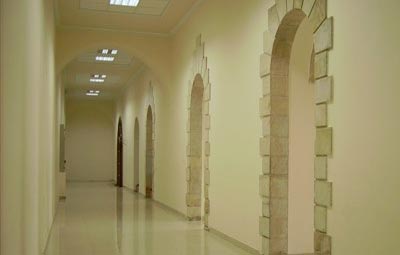
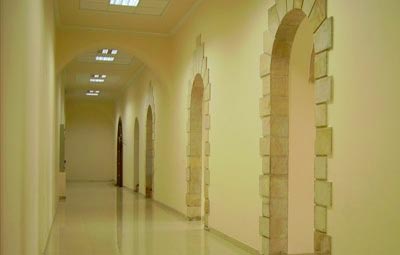
Numerous large repairs were done to the Church of the Odegitria, the sacristy of the Monastery was replenished with many ecclesiastic implements both silver and gold plated, icons and carved wood etc, while in 1985 the walls of the entrance and of the great corridor were removed and the early stone wall, the vaults and the columns of the early Christian time as well as the early paved floor of the Monastery corridors were revealed.
Description of the relics of this Monastery.
As it was earlier noted, the Monastery of the Important Monks or Monastery of the Great Theotokos is located west of the Most Holy Sepulchre and is at a distance of a stadium. The pilgrim enters in her through a small gate of the central entrance of the Monastery, into a long corridor, on each side of which are cells of nuns. At the end of the corridor with a small staircase one is led to a place ahead of the Church of the Theotokos. The Church consists of a 5th century construction as is the Catholicon of the Monastery,through the providence of Patriarch Elijah. In it, in a special place is the venerable icon of the Theotokos Odegitria, which according to tradition is the work of the Evangelist Luke. The “Platytera” (icon of the Theotokos sitting on the throne holding the child) dominates at the niche of the Holy Vema (Holy Step) and it is from the 17th century. Close to the throne of the Odegitria, on a lectern, there are two relic boxes. One of them, in carved wood and large, contains the holy relics of the Saints; James the brother of God, John the Forerunner, Haralambos, Eleftherios, Ignatios the God-bearer, Euthymios from Demetsani, Anthimus the Hieromartyr, Nichonos the “Repent”, Auksentios the holy, Hypatios the holy and Nektarios of Pentapolis, the miracle worker. The other contains the hand of Saint Jouliette and the relics of the Turkish prince Emir who in 1549 martyred for Christ. At the Monastery is also kept the hand written Holy Bible of Saint Melane as well as numerous holy icons of Christ, of the Theotokos and of many saints dating back to the 11th -18th centuries.
24. The Holy Monastery of the Seidanagia Theotokos.
Churches: 1. Saint Demetrios 2. Saint Thekla.
Cathedral Holy Church of Saint James the Brother of God, the Chapels of the Myrrh-bearer and of the 40 Martyrs, where the relics of the Patriarchs are deposited.
25. The Jewish Temple and the Wailing Wall.
The hill Morias constitutes a Jewish place of worship as from the 10 th century on which was built the magnificent Jewish Temple which is mentioned in the Old Testament and during the time of Christ. King Herod, leveling the old temple, built a new one in its place, more imposing on a higher ground, in the eastern side of which Herod built a building in the form of a basilica which served a place of meeting of the pilgrims. In this place Christ becoming annoyed and expelled the merchants who had gathered there (John 2:13).
Today only the outside walls of the Temple are saved, known as the Wailing Wall, forming the most sacred place of pilgrimage for the Jews of Jerusalem.
|
|
|
|
| |
|
|