A reliable proof concerning the basis, on which the location in question has been characterized as the Early Seat, is obtained from the treatise of pilgrim Theodosios which was written around 530AD. This mentions: “Three miles from the City of Jerusalem is the place where our Lady Mary, mother of the Lord, during her journey to Bethlehem, alighted from the donkey, sat on a stone of a rock and blessed it”. This narrative which obviously dates back in the very early Christian times is told also by Theodosios. He came from his country, Mogarisson of Cappadocia to Jerusalem, during the time of the Ecumenical Synod of Chalcedon and at the beginning he stayed close to the elder monk Logginos, who had his cell close to the surrounding areas of the Tower of David. The predecessor of emperor Urbicius who had served in the imperial court during seven emperors, set to cut that stone from its place and carve it in the form of the Holy Altar, with the intention to transport it to Constantinople. However during the transportation, when they reached the city of Saint Stephen at Jerusalem, the stone which was being transported on a horse drawn cart, became impossible to transport any further and for this reason they brought it back to the Tomb of the Lord and placed it there as stone of the Holy Altar. About Urbicius it is learnt that he died and was buried in Constantinople and that the tomb did not keep him but ejected him three times. No doubt can exist that the stone which according to tradition, was used as a relaxation seat by the mother of the Lord during her journey to Bethlehem, is identified with the location and in mid-5th century it became known by the name “Early Seat”. In its environs a church was built in honour of the Theotokos ca 451AD by an older, pious and rich woman called IKelia, of Jerusalem. As concerns the time of the stone removal by Urbicius, we cannot provide accurate validations. Taking into account the available information, it can only be said that the transfer of the stone took place during the second half of the 5th century. That the early tradition on the place was kept alive, is testified by the following information, which comes from the following century, from Antoninus of Placentia, when he describes the tradition in the following manner which varies minimally from the description of the pilgrim Theodosius: “At mid-journey which leads to Bethlehem, I saw water gushing out of a rock, at my estimation with the force of six “ksestion” (early measure of unit fluid power). From this everyone drunk to quench their thirst, with “the water neither diminishing nor increasing”. It was drunk with pleasure. This happens, as it is said, because blessed Mary during her flight to Egypt sat on this place with her son and quenched her thirst. Since then the water has not stopped flowing. Now a Church is built there. From there to Bethlehem is three miles. Without doubt the church of the Seat was built there about 120 years earlier by Ikelia. Another source as well, from which we can obtain elements and which derives from the beginning of the 12th century is the narrative of the Russian Abbot Daniel around 1115AD which says: “Coming out of Jerusalem, we arrive after two “Verts” (old unit of distance) through the fields in the place of Abrahams Tabernacle, where he left his servant with his donkey etc. From there though it is one “verts” to the place where the Theotokos saw two type of people, one laughing and the other crying and a large Church was built there in the name of the Holy Theotokos. Now however this place is destroyed by the unbelievers”. We do not hesitate to suggest that the cistern which Christians call by such names as: “Spring of the wise”, “Spring of the Three Kings”’ “Cistern, the spring of the Star” and it is situated on the road to Bethlehem, 160 meters north of Prophet Elijah, is identified with the spring which Antoninus associated with the Church of the “Seat”. This view seems to have a decisive importance not only with the agreement on the location of the place (3 miles from Jerusalem) but also by the name of this cistern used by the Arabs, such as Bir Cantisma, a name which we see being maintained and which comes from the ancient name Cathisma (seat) from the early Greek-Christian period.
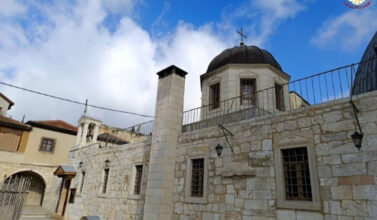
Of course the tradition concerning this location, as a place of relaxation of the Theotokos continued being maintained at the time, to the point which, from the beginning of the 14th century it was indicated to be a short distance from the cistern, referred to as the cistern of the Magi, and on the left side of the road, there was a turpentine tree which was standing alone, a bit leaning, not too tall but quite strong which remained honoured by the name “Turpentine tree of Mary”, because in its shadow the Theotokos rested, when on the 40th day after the birth of the Lord she offered the sacrifice at the Temple in Jerusalem. In 1645, the Turpentine tree was torched by an Arab to stop the pilgrims from stepping on his field. Today the spring of the Magi is a dry cistern of regular architecture and is located on the road between Jerusalem and Bethlehem, at a distance of about 800 steps from Prophet Elijah. A stone pile at the end, enable us to state that at some time a wall stood there. In this we recognize without doubt the last remnants of the once “Church of the Seat” or of “The Theotokos” in mid-5th century. The real location is connected with a very early Christian tradition on the life of Mary to which is owed its importance and justification. In June 1992 when the section of the road near Bir-Cantisma (about 300 meters north of the monastery of Prophet Elijah) was being built, a coloured mosaic was exposed and a large base of a column made of stone as well as two gate-columns. The work was interrupted due to the quick action of the archeologist Jacob Bilig from the archeological service, who at that time was excavating nearby. About four and a half months later he started the excavation for the retrieval, for the archeological service under the direction of Rina Abner. The limits of the excavation were restricted by the direction of the planned road which was to connect Jerusalem to the region of Hebron.
The purpose of the excavation was for the protection of the archeological relics and the perseverance on their importance. Given that the area of the excavation was limited by the direction of the planned road, only a small part of the western section of the Church was discovered, as well as walls and coloured mosaics which belonged to the monastery or guest house that were attached to the Church. The relics that were discovered during the excavation are in accord with the determination of the Church and the monastery of the Seat at Bir-Cantisma as proposed at the end of the century during which Erhard lived and in the footprints of Vailhe and other researchers (Erhard 1891:258, Vailhe 1899:523-524, Koikyaidoy 1906:18-20).
The “Seat” is known from sources of which the most important are: The life of Saint Theodosios by Kyrill the Skythopolitan (Pub. Schwart 1939:276, 20) and the “Life of Theodosios by Theodore, Bishop of Petra: (Pub. Usener 1890:13). In the year 1934, Schneider proposed the identification of the Church of the Seat with Ramat-Rahel (Schneider 1934:230-231). This identification became accepted following the excavation of the Church of the Basilica and of the monastery at Ramat-Rahel by Aharoni (Aharoni 1962: 73-92). The results of the excavation support the identification of the “Seat” with the Octagonal Church, in its courtyard in which there was a sacred cistern at “Bir-Cantisma” (which is called by the pilgrims as “cistern of the Magi” and “cistern of the three wise men” or of the three elders). The Arabic name for “Cadisma” preserves the early Greek name of the place “Cathisma”. The rock around which the Church was built, the dimensions of the Church and its octagonal plan testify in favour of the identification of the seat with the archeological area, which was discovered at Bir-Cantisma.
The topography of the seating provides the possibility of its complete validation with the Church. We are informed from many sources, that the most holy feast in honour of Mary, the one known to us today, was celebrated at the “Seat”. Kyrill the Skythopolitan narrates that Ikelia established a candle procession as a custom at the “Seat”. In the Armenian horologion it is referred as a feast of commemoration on the 15th August at the “Seat” which is located at a distance of three miles from Jerusalem (Capelle 1942:8). In the Georgian Typicon the feast was moved to the 13th August and a second feast is celebrated at the “Seat” on the 2nd-3rd December (Capelle 1942:20-21). Capelle showed interest on the liturgical and these sources and tried to explain the moving of the feast day of commemoration which is celebrated at the “Cathisma” (Seat). In his opinion emperor Mauricius adopted the original date of the feast at “Cathisma” and changed to the feast of the Metastasis (transference) of the Theotokos Mary to Heavens, which is celebrated on the 15th August at the tomb of Mary at Gethsemane (Capelle 1942:32). In the opinion of Capelle the “Cathisma” is the only early church whose liturgy conformed completely with the documents which are with us today (Bibliography New Sion, Ecclesiastical Treatise Journal, Issue, Holy Coenobium of the Most Holy Tomb, Vol. 86, January-December 1994, page 227-238). Saint John Chrysostom says: “No one would have faulted by saying the Church is more valuable than the Ark. Because the Ark took in the animals and preserved them, while the Church takes animals and transforms them. Let me use some examples. In the Ark entered a crow and came out a crow, a wolf came in and a wolf came out. Here in the Church someone enters as a crow and comes out as a dove, comes in as a wolf and comes out as a sheep, comes in as a snake and comes out as a lamb, because nature does not change but the evil is expelled”. |